


Weavers' solution for insatiable demand for wahakura

Te Wānanga o Aotearoa weavers inundated with requests for wahakura have found a solution that may help to satisfy the overwhelming demand for the traditional bassinets.
Te Kāwai Raupapa ki Papaioea kaiako Jenny Firmin said there is an ongoing demand for wahakura, the traditional sleeping enclosure that is aiding in the prevention of Sudden Unexpected Death of an Infant (SUDI).
The problem they’re having, however, is it’s a big ask for them to meet both the demands of mothers and health providers and their course curriculum.
“The interest in them has been huge,” says Jenny.
“I personally get about two calls a week for them and we have had Whanganui DHB contact us and I think they wanted something like 30,000 of them or some crazy number.”
Statistics from Plunket NZ show that New Zealand has the highest rate of SUDI (Sudden Unexpected Death of an Infant) in the developed world.
Māori SUDI rates make up two thirds of all of the approximately 65 deaths each year.
But the wahakura is being hailed as a success to halt these preventable deaths by promoting healthier sleeping habits for babies and their parents, who sometimes bedshare with them.
Doctor and SUDI prevention specialist David Tipene-Leach last year told Radio New Zealand that smoking while pregnant damaged the baby's respiratory system.
When those babies sleep with their parents the risk of overheating and suffocation is higher than for healthy babies.
He said wahakura were part of a Māori approach that had been developed to combat SUDI and hundreds of them had been rolled out since 2012.
The result: a 30 per cent drop in infant mortality across New Zealand.
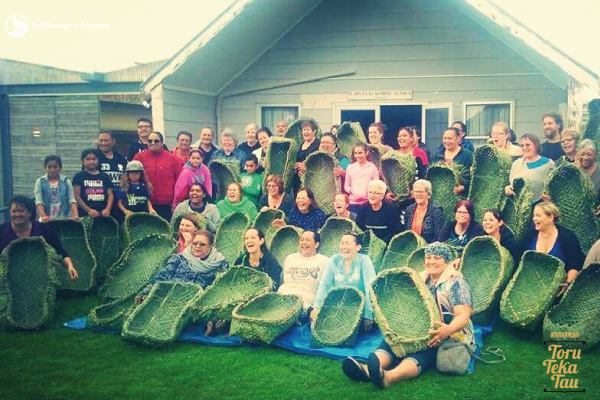
Tauira at a recent raranga noho held in Whanganui show off their creations.
Last year level 4 students of Kāwai Raupapa Certificate in Māori Visual Arts (Raranga) wove wahakura before donating them to a local iwi health centre, Te Kete Hauora o Tamaki nui a rua in Dannevirke.
The 11 wahakura were destined for young mothers and their babies and were part of a project developed by Dr Tipene-Leach in 2001.
Jenny said with the surging popularity of wahakura they had come up with an idea to help meet the demand.
“There is a lot of interest from places like Ngāti Kahungunu to go over there and do workshops now.”
“At first they were like, “we will buy them off you” because they wanted 60 of them but then I had an idea and said “how about we teach you instead?”
“We will teach you how to harvest and karakia and how to make these things beautiful and then you practice and teach someone else.”
“We want this to go throughout the motu to benefit our tamariki and mokopuna.”
Jenny said the ongoing feedback she was receiving from health professionals about the traditional sleep baskets was overwhelming.
“I spoke with a midwife last week when we were out harvesting and she spoke about how beautiful they are and how they have saved so many babies’ lives in the short time they have been around.”
We get lots of feedback not just formal, a lot of it is informal. From the professional side a lot of midwives know about them but they just don’t know how to source them so hopefully this will change.” “It takes a good two days for an experienced weaver to make a wahakura so I have learned to have a bit of a supply at the ready.”
Pūrongo whakahirahira
Featured stories

Vote at Te Wānanga o Aotearoa in the 2026 General Election
Selected Te Wānanga o Aotearoa campuses will be open as voting places during the 2026 General Election, making it easier for tauira, kaimahi, whānau and our wider communities to have their say.

Te Wānanga o Aotearoa launches new reo Māori programmes to help te reo thrive for generations to come
For over four decades, Te Wānanga o Aotearoa has created pathways for generations of tauira to learn, speak, teach and live te reo Māori. That legacy has supported the return of te reo Māori to everyday life, from whānau learning their first kupu, to tauira carrying reo onto marae, and into workplaces, classrooms and homes.

Turning a passion for rongoā into community healing
Rongoā Māori has always been part of Patricia Tangira-Falwasser's life, but it was her studies at Te Wānanga o Aotearoa that deepened her knowledge and inspired her to start a business that now serves her wider community.

Te Wānanga o Aotearoa kaimahi claims gold at Waka Ama World Championship
Ken Henry (Te Whakatōhea, Waikato-Tainui) is a Tauira Support Advisor at Te Wānanga o Aotearoa Whakatāne campus who took home gold at the Waka Ama World Championships in Singapore in August.

A passion for taonga Māori takes Chanel to Oxford
What started as a desire to strengthen her reo Māori has taken Chanel Coromandel (Ngāti Raukawa, Ngāti Hine, Ngāti Apakura, Ngāti Whanaunga) on an unexpected path, leading to an opportunity to contribute to the care and preservation of taonga Māori at the Pitt Rivers Museum in Oxford, England.

Reconnecting to te ao Māori through raranga
Haylee Roussel (Ngāti Rārua, Rangitāne, Ngāti Maniapoto) was searching for a way to reconnect with te ao Māori when she enrolled in the Certificate in Māori and Indigenous Art, Raranga, at the Waiwhero campus of Te Wānanga o Aotearoa.

A journey shaped by whānau and a love of tamariki
Members of Tayla-Marie Takawe’s (Ngāti Awa, Ngāti Maniapoto) whānau were among the first tauira to graduate from the Bachelor of Education (Primary Teaching) at Te Wānanga o Aotearoa.

Finding a deeper sense of self through te ao Māori
Moving to Aotearoa from rural Australia as a teenager, Lily Warring found herself wanting to learn more about the culture and language of the place she now called home.

Creating the spark for business success
With plenty of experience as an electrician, Josh Verstraten was ready to branch out from employee to business owner, but he knew running a successful business would require a new set of skills.

From financial stress to financial freedom for Auckland whānau
For Augustine Kopa, studying the Certificate in Money Management at Te Wānanga o Aotearoa was about creating a better future for her whānau.

